Lay out the two main routines
Empty the drawer onto a clean dry towel, then group the contents by what happens in the morning and evening. Tooth care, shaving, skincare and hair accessories may each form a small group. Notice products that are shared between routines and keep them where either sequence can reach them. Remove empty packaging and follow labels when checking whether products remain suitable to use.
Keep items requiring particular storage conditions somewhere appropriate; the bathroom is not automatically right for medicines, electronics or every cosmetic. The drawer's job is to support the routines that happen here, not to hold the household's entire personal-care collection. Separate unopened reserves before choosing dividers so they do not dictate the daily arrangement.
Work around the drawer itself
Measure the drawer's usable depth and height, including any space taken by the basin or pipework. Open and close it with the tallest products inside to check clearance. Upright bottles are easy to read when they fit securely, while tubes may work better lying in a shallow compartment with labels visible. Avoid a layout that puts pressure on caps or pumps whenever the drawer closes.
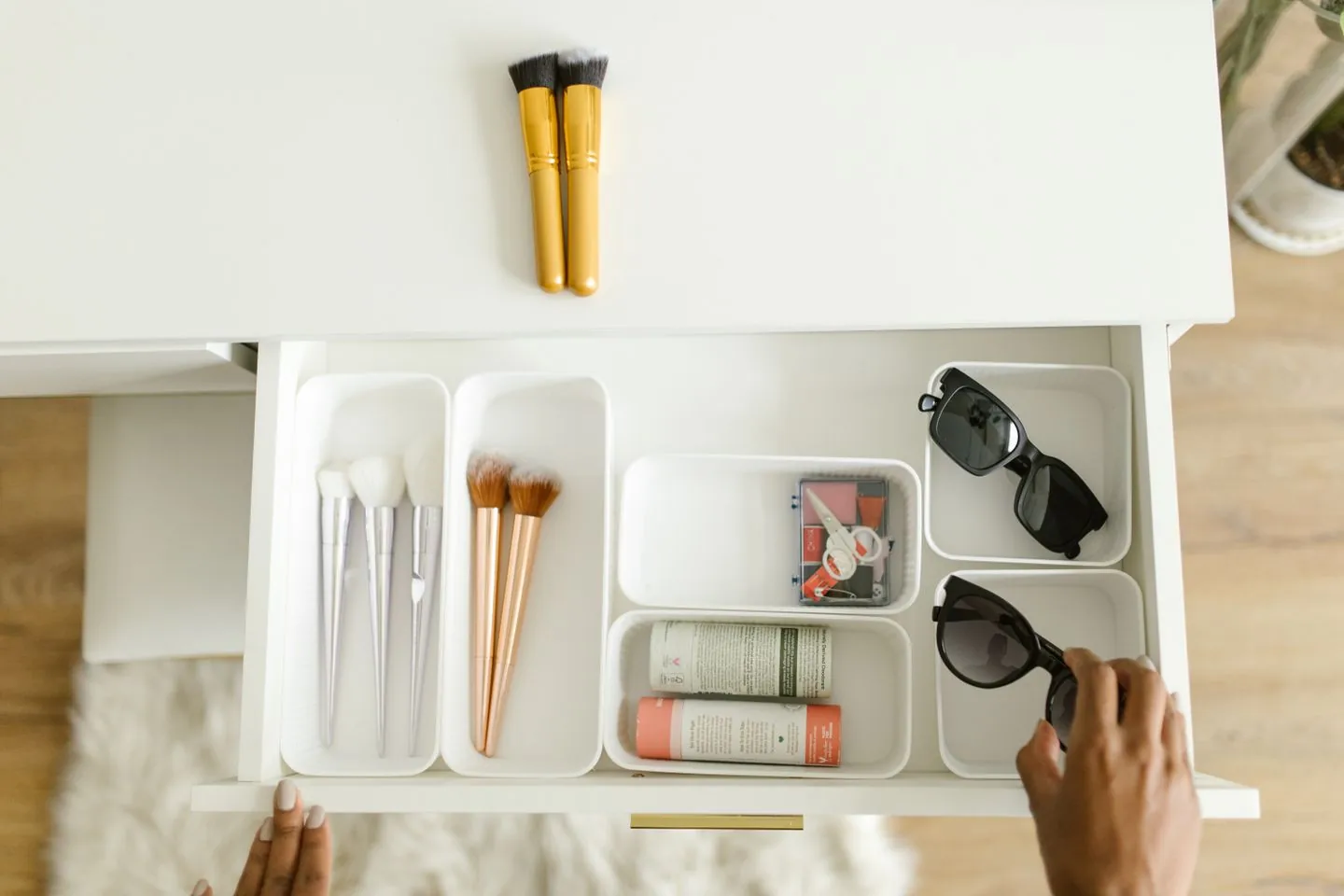
Use a few washable inserts rather than one elaborate tray with compartments too small for the actual products. Removable sections make cleaning easier if a bottle leaks. Leave space to lift each insert without emptying the whole drawer. A non-slip base may help prevent movement, provided it can be cleaned and does not hold moisture against a vulnerable surface. Keep product names facing upwards where possible so similar tubes can be identified without opening them.
Put the daily sequence at the front
Arrange the first items used in the most accessible section, with later steps beside or behind them. This might mean toothbrush supplies at the front, followed by a small skincare group. There is no need to reproduce every step exactly if that makes shared storage confusing. Clear categories should come before a rigid sequence.
For more than one person, separate small containers can prevent similar products being mixed up. Keep shared tools in a distinct group where everyone can find them. Sharp grooming items need suitable protected storage and appropriate access for the household. Do not leave hot styling tools in a closed drawer; let them cool and follow their storage instructions. Cords should return loosely without trapping connectors beneath other items.
Leave room for imperfect mornings
The drawer needs to accept a quick return. If every tube must lie at a particular angle for it to close, reduce the contents or change the compartment sizes. Keep a small reserve area elsewhere and refill the daily group only as products run out. This makes duplicate buying easier to avoid and prevents half-used bottles spreading across the drawer.
After several days, look at what has migrated onto the basin. A product may be used more often than expected, or the drawer may be difficult to open while standing at the mirror. Adjust its position instead of relying on more disciplined tidying. Wipe inserts and the drawer base as needed, allowing them to dry before replacing products. The useful result is a clear view of the next item and a simple place to put it back.
Organise around familiar routines, protect sharp tools and keep the daily drawer separate from backup supplies.
A Swishover guide · Practical ideas to adapt to your own home.
Spotted something we should improve?