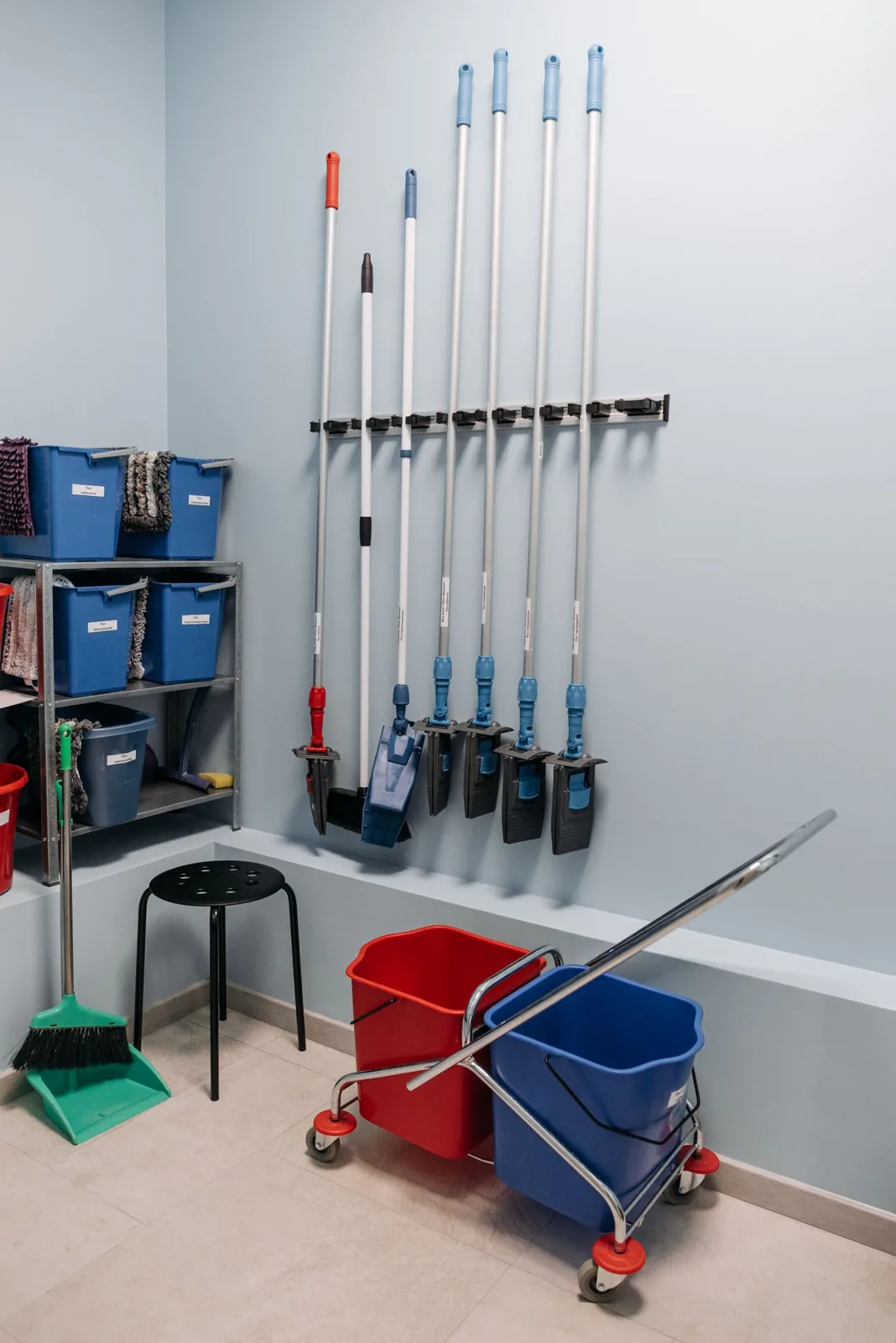
Group tools by the work they do
Gather cleaning tools from their scattered locations and separate them by task. Floor care, bathroom cleaning and general dusting may need distinct groups, particularly where keeping tools separate prevents inappropriate reuse. Keep only equipment that is serviceable and relevant to the surfaces in your home. A broken brush awaiting an unlikely repair should not occupy the best hook. Check the care instructions for reusable pads and heads so they can be cleaned and stored properly. The aim is a collection that supports actual jobs, not a cupboard containing every tool bought for a different home or an abandoned routine.
Find a dry home for long handles
Brooms and mops are easier to retrieve when they are held upright or hung on fittings designed for their shape and weight. Measure the full handle length before adding a rail, and allow room to lift the tool off its hook. A fitting placed just below the ceiling may hold the handle but make removal impossible.
Use suitable fixings and keep the tools from falling into the doorway. Avoid balancing a mop behind a door where opening it releases the handle. Wet heads need to dry in an appropriate ventilated position before they return to enclosed storage; hanging them neatly inside a closed cupboard does not solve the moisture problem.
Separate tools from products
A portable caddy can carry the supplies for one job, but it should remain light enough to lift comfortably. Cleaning products need their original labels, secure closures and storage consistent with their warnings. Keep them appropriately secured where children or vulnerable people may reach them. Do not combine different products or use food containers to make the caddy look coordinated. Clean tools and spare cloths can occupy a separate open compartment, with used cloths going to their proper washing or drying place rather than back into the clean group.
Give the vacuum its complete space
Plan for the vacuum body, charging arrangement if relevant, hose and the attachments you actually use. Follow the manufacturer's charging, ventilation and storage guidance. A machine squeezed into a cupboard may be hard to remove without knocking down everything around it. Leave enough room to grasp its handle and unwind the cable or detach it safely.
Keep useful nozzles in a nearby labelled container or on their designed holder. Unknown attachments do not need to fill the floor around the machine; identify them and store occasional pieces separately. Check that the cupboard door does not press against the hose or strain a charging connector.
Make returning the last step
After a cleaning session, empty or clean equipment as its instructions require and allow damp parts to dry. Then return each tool to its clear position. This is easier when storage has a little spare room and does not depend on one exact arrangement. Place the most frequently used tool nearest the opening rather than hiding it behind a large occasional appliance.
Review the awkward object
One item often causes most of the disorder: a bucket that does not fit, an ironing board blocking the vacuum or a mop that never stays upright. Solve that specific conflict instead of buying a whole new storage system. Move an unrelated object elsewhere, change a hook height or reduce duplicate tools. Keep the cupboard floor visible enough to clean and to notice spills. A useful tool store makes starting the next job straightforward, while allowing equipment to remain dry and in good condition between uses.
Store tools by task, allow wet parts to dry and make the largest appliance easy to remove.
A Swishover guide · Practical ideas to adapt to your own home.
Spotted something we should improve?